
 English
 Español
 Pусский
 Deutsch
 日本語
日本語 हिन्दी
 Indonesia
 Melayu
 Tiếng Việt
LED 광화학 반응기
An LED photochemical reactor is a specialized system designed to carry out light-driven chemical reactions efficiently and safely. It uses light-emitting diodes as the irradiation source, providing a controlled and energy-efficient way to initiate photochemical processes. Compared with traditional mercury lamps or other high-intensity light sources, LED-based reactors offer several advantages, including lower heat generation, longer service life, improved wavelength specificity, and reduced energy consumption. These features make them increasingly important in both laboratory research and industrial-scale synthesis.The core function of an LED photochemical reactor is to expose a reaction mixture to a specific wavelength of light under carefully controlled conditions. Many photochemical reactions depend on the absorption of photons by a catalyst, reagent, or substrate. Once activated, the molecules enter an excited state and can undergo transformations that are difficult or impossible under conventional thermal conditions. Because LEDs can be selected to emit narrow wavelength bands, they allow precise matching between the light source and the absorption profile of the photoreactive species. This improves reaction efficiency and selectivity.A typical LED photochemical reactor includes a reaction vessel, an LED lighting module, temperature control components, and sometimes stirring or mixing systems. The reactor chamber is often designed to ensure uniform light distribution so that all parts of the reaction mixture receive consistent irradiation. Effective mixing is important because photochemical reactions can be limited by light penetration, especially in opaque or concentrated solutions. Temperature control is also essential, since unwanted heating can influence reaction pathways or reduce product quality. Some advanced systems integrate cooling fans, circulating water jackets, or thermoelectric devices to maintain stable operating conditions.LED photochemical reactors are widely used in organic synthesis, material science, environmental chemistry, and pharmaceutical development. They can support processes such as photooxidation, photocyclization, radical generation, dehalogenation, and photocatalytic coupling reactions. In research laboratories, they are valuable tools for exploring new reaction mechanisms and optimizing light-mediated transformations. In larger-scale applications, they can improve reproducibility and make continuous-flow photochemistry more practical.Another important benefit of LED photochemical reactors is safety. Because LEDs operate at lower temperatures and do not contain fragile glass bulbs or toxic metals commonly associated with some older light sources, they can reduce operational risks. Their compact size and modular design also make them easier to install and adapt to different experimental setups. In addition, the ability to turn LEDs on and off instantly provides better process control and can simplify automation.In summary, an LED photochemical reactor is an advanced platform for performing light-induced reactions with high precision, efficiency, and safety. By combining wavelength control, stable irradiation, and thermal management, it supports modern photochemistry across a wide range of scientific and industrial applications.
제품
범주:
-
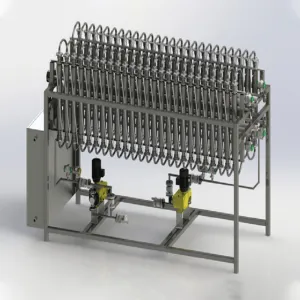
연속 흐름 광화학 반응기
분류: 연속 흐름 광화학 반응기조회수: 840번호:릴리스 시간: 2026-07-11 15:42:05연속 흐름 광반응기는 연속 흐름 공정과 광화학 반응을 깊이 통합합니다. 이는 기존 케틀 반응기의 센티미터 수준에서 밀리미터 또는 마이크로미터 수준으로 광학 경로를 단축하여 광자 활용률과 반응 효율성을 크게 향상시킵니다. 정밀한 다중 채널 병렬/직렬 구조로 지원되는 반응물은 균일한 조명 하에서 지속적이고 안정적으로 흘러 질량 및 열 전달의 이중 향상을 달성하여 제약, 정밀 화학 및 신소재 산업을 위한 산업 등급의 신뢰할 수 있는 솔루션을 제공합니다.
뉴스
범주:
검색 결과가 없습니다!
케이스
범주:
검색 결과가 없습니다!
비디오
범주:
검색 결과가 없습니다!
다운로드
범주:
검색 결과가 없습니다!
모집
범주:
검색 결과가 없습니다!



 왓츠앱
왓츠앱 핸드폰
핸드폰